
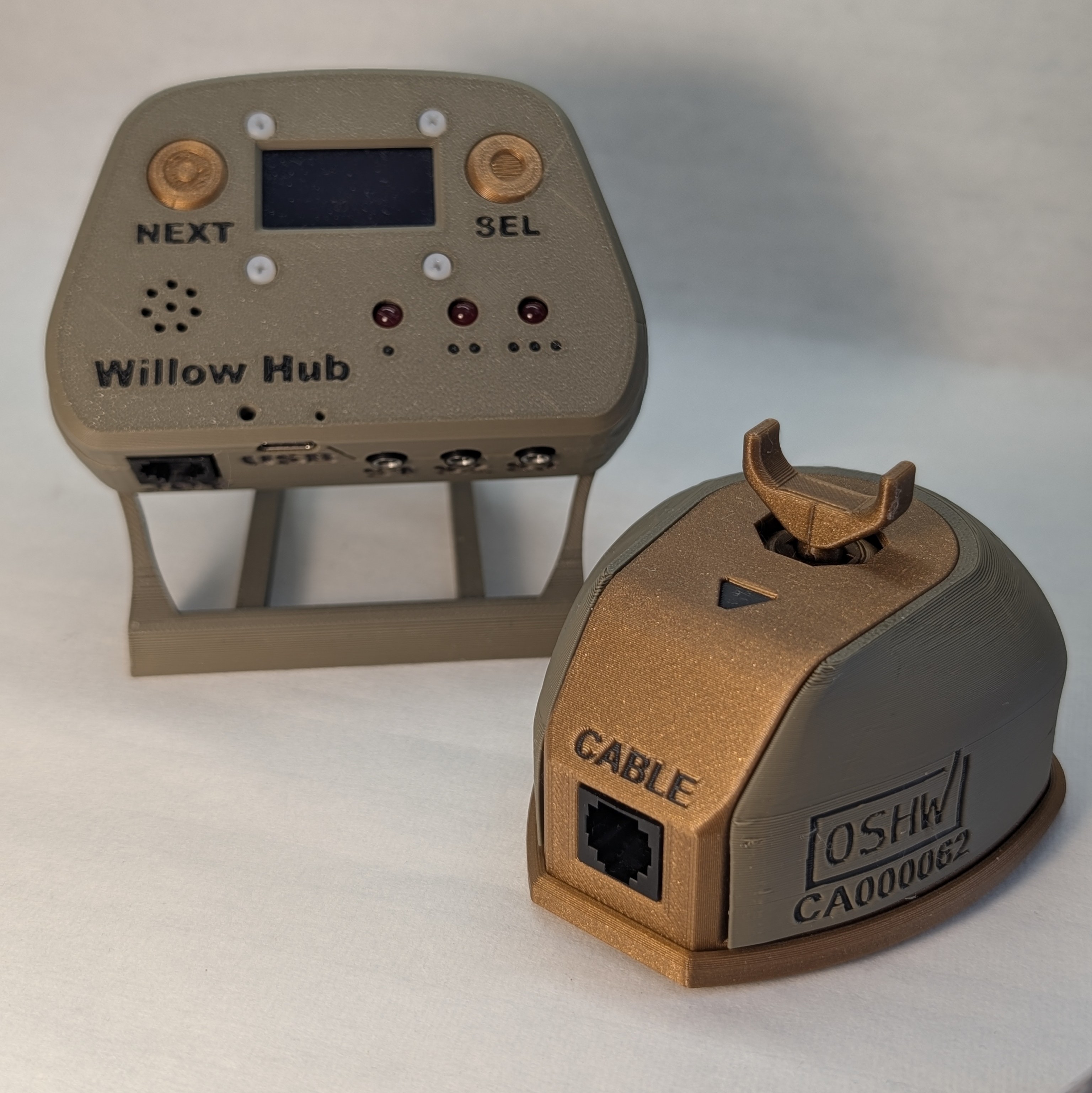
Willow USB Joystick
The Willow joystick allows users with low force/range of motion to access their digital devices for cheaper than a commercial option.
 Electronics
 Custom PCB
 3D Printing
 2
2 26
26 0
0 942
942Device Information
Overview
The Willow is made up of the Willow Joystick and the Willow Hub. The Joystick is the primary user interface and contains a low-force Hall-Effect joystick. The Hub has a display that provides a graphical interface for independently adjusting settings, as well as it provides the connection to the host device and up to three external assistive switches with 3.5 mm jacks.
The Willow is compatible with a range of host devices that can support a USB Mouse, a USB Gamepad and/or a Bluetooth Mouse. Compatible devices include PC and Mac computers and laptops, Android, iOS, and Windows smartphone and tablets, and the Xbox Adaptive Controller. As a USB joystick, the Willow is not compatible with the Sony Playstation Access Controller.
The joystick requires 25 grams of force to operate and comes with 7 different swappable toppers. It has adaptors for both ¼-20 mounting arms and RAM B ball mount arms and has an optional nonslip base for use on a table. There is also a modifiable wrist ramp to help raise a user’s wrist while using the joystick.
The Willow is Open Assistive Technology (OpenAT) and is certified as Open Source Hardware by the Open Source Hardware Association under the OSHWA UID CA000062. Under the terms of the open source hardware licenses, the Willow may be built, used, and improved by anyone.
How To Use
A brief Quickstart Guide, and detailed User Guide are available on GitHub.
Compatibility
The Willow can emulate a USB Mouse, USB Gamepad, or Wireless Bluetooth Mouse. It is compatible with a variety of host devices:
- Phone: Android 4.0+, iOS 13+*, Windows
- Tablet: Android 4.0+, iOS 13+*, Windows
- Computer & Laptop: Windows, MacOS
- Xbox Adaptive Controller (Left and Right USB ports)
*iPhones and iPads running on iOS 13+ require a USB hub for the iOS device to recognize the Willow.
Setup
The Willow Hub should be mounted so that the display is visible and ideally close to the host device. The Willow Joystick is connected to the Willow Hub using the Willow Interface Cable.
The Willow Hub needs to be powered through the USB cable by a USB port on the host device, or a USB power pack.
Connection to Host Device
The Willow requires both a data connection and a power connection. The setup will differ depending on whether it is a wired host device for USB Mouse Mode or USB Gamepad Mode or a wireless host device for Bluetooth Mouse Mode.
Connection to Wired Host Device
For a wired connection, a USB cable must be connected from the USB-C port on the Willow Hub to the host device. By default, the Willow is supplied with a USB-C to USB-A cable. Depending on the host device, a different cable, adaptor, or powered USB Hub may be required. Refer to the User Guide.
Connection to Wireless Host Device
For wireless connections, the Willow Hub only needs to be connected to a power source. Connect the USB cable to a suitable USB port
Usage
The Willow will produce different outputs depending on whether the operating mode is USB Mouse, USB Gamepad, or Wireless Bluetooth Mouse. Moving the joystick topper will move the cursor or joystick. The buttons on the Hub or attached assistive switches can also be used to provide input to the Willow.
Changing Settings
A visual menu on the Hub can be accessed using the Hub buttons or assistive switches. This menu can be navigated using two inputs to change various settings, including changing the operating mode, activating calibration, adjusting cursor speed, and restarting the device.
Disability Type Description
The Willow would be useful for users with conditions that limit their strength and range of motion, such as Spinal Muscular Atrophy.
Estimated Cost (CAD)
Maker Information
Skills Description
The Willow Hub involves mostly soldering, attaching through hole components to a PCB. The Willow Joystick is mostly assembling 3D printed parts, with some slight soldering. Assembling the gimbal does require
Print Time (hrs)
9
Assembly Time (hrs)
2
Tools Needed
Common Hand Tools;3D Printer;Soldering Iron
Build Instructions
The Willow hardware consists of off-the-shelf electronics and hardware components, 3D printed components, and a single custom printed circuit board (PCB). It is divided into two main parts: the Willow Joystick and the Willow Hub. The Willow Joystick contains the joystick components and utilizes plug and play STEMMA QT / Qwiic breakout boards to streamline the building process. The hub is a PCB and plug and play display mounted in a 3D printed enclosure, and the joystick unit is a 3D printed gimbal mechanism containing a sensor breakout board in a 3D printed enclosure.
Refer to the Maker Guide for detailed instructions.
Project Link
Please login or register to agree to the MMC Terms of Use to access the Project Link
License
Attribution
The Willow was designed by Neil Squire Society / Makers Making Change.
The latest design incorporates several commercially available open source hardware components from Adafruit and SparkFun. The Willow firmware utilizes the Arduino development platform, and a number of libraries developed and shared by the open source community. Full details are available on GitHub.
Reviews

There are no reviews for this device