
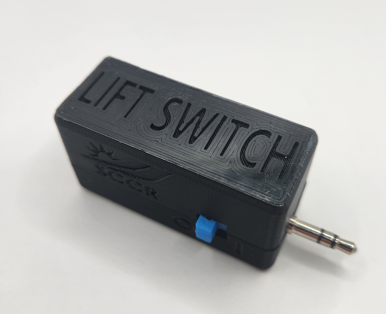
Lift Switch
For assistive switch users who would like to activate their switch by resting on the switch and lifting off, instead of pushing down, the Lift Switch Interface will modify the output of any standard 3.5mm assistive switch!
 Electronics
 Custom PCB
 3D Printing
 Software
 4
4 41
41 0
0 1.7k
1.7kDevice Information
Overview
The Lift Switch is a device that modifies the output from your assistive switch. The primary case is for a user who would prefer to rest on their switch and lift off of it to activate it, instead of requiring the user to hover over the switch. There are four operating modes: momentary, latching, timed latch, and reverse acting, described below:
- Momentary – The output will turn on momentarily when you lift off of the assistive switch.
- Latching – The output toggles between on/off when you lift off of the assistive switch.
- Timed Latch – The output will turn on for a set amount of time (7s) when you lift off of the assistive switch.
- Reverse Acting - Reverses the action of an assistive switch. Assistive switch off (not activated) = Lift Switch on, Assistive switch on (activated) = Lift Switch off.
The Lift Switch can also be used as a mouse click in any of the above modes, by plugging the Lift Switch into a computer through a USB cable.
How To Use
To use the Lift Switch, simply plug in an assistive switch into the 3.5 mm jack, and plug the other end of the lift switch into your switch adapted device.
To change operating modes, press the Mode button located on the side of the Lift Switch. The selected mode is indicated by the light colour, as described below:
- Green - Momentary – The output will turn on momentarily when you lift off of the assistive switch.
- Blue - Latching – The output toggles between on/off when you lift off of the assistive switch.
- Yellow - Timed Latch – The output will turn on for a set amount of time (7s) when you lift off of the assistive switch.
- Red - Reverse Acting - Reverses the action of an assistive switch. Assistive switch off (not activated) = Lift Switch on, Assistive switch on (activated) = Lift Switch off.
To use the Lift Switch as a mouse click, simply plug it into your computer, tablet, or smart phone, using the correct cable or adapter, and put it into the mode that would work best for you.
Disability Type Description
The Lift Switch is designed primarily for disabilities that affect a user’s strength and endurance. The Lift Switch also enables use of switch sites where a user has movement but would otherwise choose not to use it due to ergonomic considerations, for example an accessible switch under an elbow when resting on an armrest. The Lift Switch has been used by people with various disabilities and diagnoses such as ALS, Muscular Dystrophy and MS.
Estimated Cost (CAD)
Maker Information
Skills Description
This build involves an intermediate level of 3D printing, soldering, Arduino firmware, and assembly. It also involves ordering a custom PCB. This build has some surface mount soldering.
Print Time (hrs)
2
Assembly Time (hrs)
1
Tools Needed
Common Hand Tools;3D Printer;Soldering Iron
Build Instructions
The Lift Switch hardware consists of off-the-shelf electronics and hardware components, 3D printed components, and a custom printed circuit board (PCB). The build consist of soldering the parts to the PCB, flashing Arduino code to the microcontroller, and assembling the enclosure. For more detailed build instructions, see the Maker Guide.
Project Link
Please login or register to agree to the MMC Terms of Use to access the Project Link
License
Attribution
The Lift Switch was designed by the Rehabilitation Engineering Department at Horizon Health’s Stan Cassidy Centre for Rehabilitation (SCCR). Development was supported through the Government of Canada’s Innovation Science and Economic Development Accessible Technology Program (ATP). The ATP program enabled SCCR to deploy numerous Lift Switches to users at reduced cost.
The latest design incorporates feedback and suggestions from numerous users, clinicians, and volunteer makers.
The latest design incorporates several commercially available open source hardware components from Adafruit. The Lift Switch firmware utilizes the Arduino development platform, and a number of libraries developed and shared by the open source community. Full details are available on the GitHub repo via the Project Link.
Contributors:
- Rachelle Bernier, Horizon Health Network.
- Marla Calder, Horizon Health Network
- Natasha Hanson, Horizon Health Network
- Dorian Hawkes, Horizon Health Network
- Rick McCaskill, Horizon Health Network
- Billie O’Connor, Horizon Health Network
- Kristen Culberson, Horizon Health Network
- Josie Versloot, Neil Squire Society / Makers Making Change
Reviews

There are no reviews for this device