
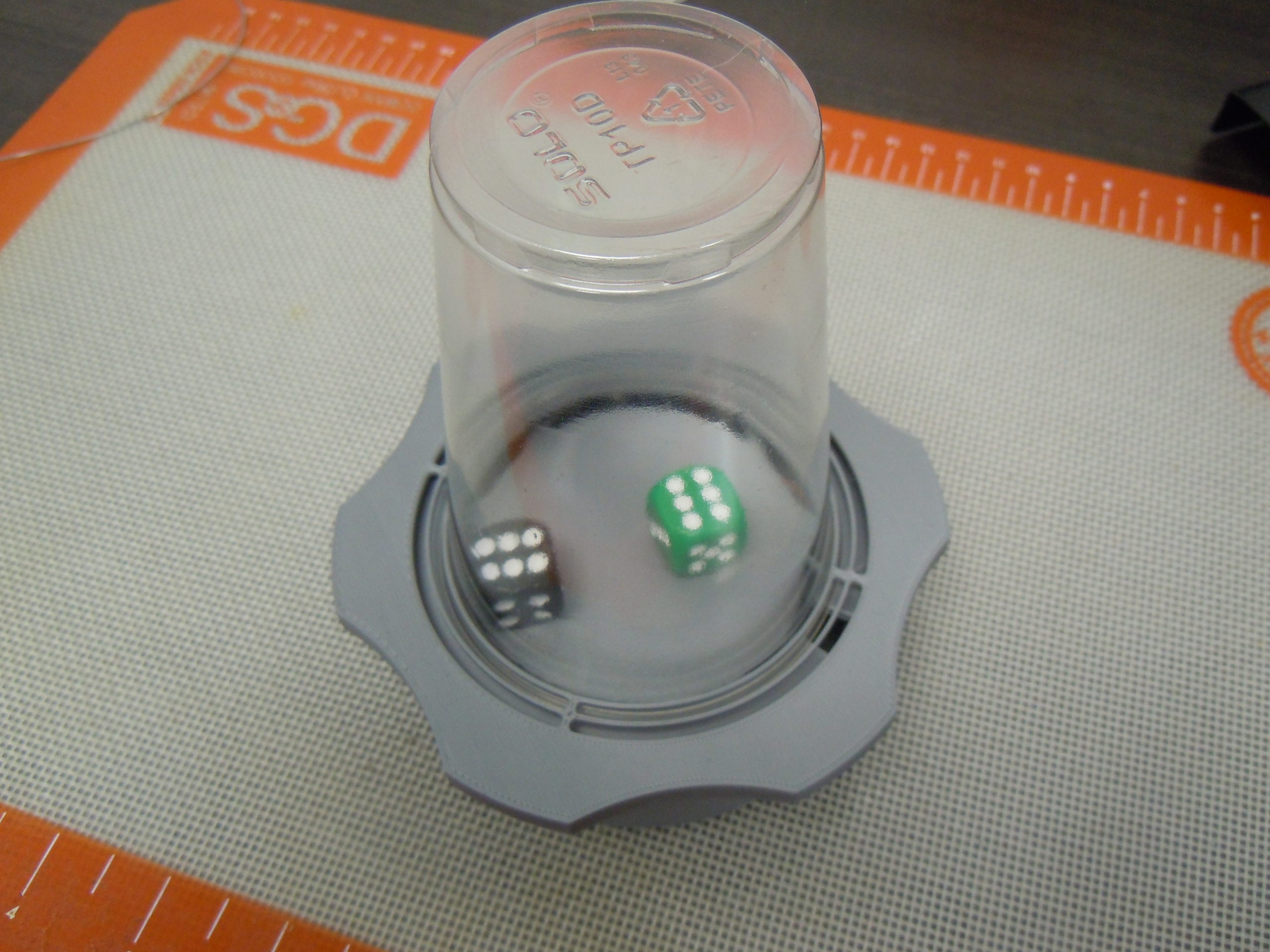
Rumble Plate Dice Roller
If you find rolling dice difficult, the Rumble Plate Dice Roller is the perfect device to make game night accessible for everyone.
 Mechanics
 3D Printing
 7
7 122
122 0
0 2.1k
2.1kDevice Information
Overview
This switch activated dice roller makes any dice game more accessible. With a simple push of an assistive switch or on the plastic cup itself, the dice housed in the clear plastic cup will tumble around. A sure hit for board game night!
The Dice Roller can be activated using an assistive switch, a button on the device, or by pushing down on the Dice Roller with an optional Vertical Push Base. When activated, the plate inside the Dice Roller will move up and down and cause the dice to bounce and tumble.
The Dice Roller requires two AAA batteries to operate.
How To Use
Setup:
- Place the Dice Roller on a flat, stable surface.
- If using, connect the assistive switch by inserting the 3.5 mm plug into the jack on the side of the tumbler.
- If you want to activate the tumbler by pushing down on the cup, insert the Dice Roller into the Vertical Push Base.
Usage:
- Activate the Dice Roller for a couple of seconds to roll and tumble the dice. The dice tumbler can be activated in three ways:
- Activating an attached assistive switch.
- Pressing the circular button on the side of the Dice Roller.
- Pressing down on the plastic cup (when used with Vertical Push Base).
Changing Dice:
The dice can be changed out by untwisting the lid and removing the cup.
Changing Batteries:
The Dice Roller uses 2 AAA batteries. The batteries can be changed by unscrewing the Lid, removing the retaining, and removing the plate to access the battery holder.
Disability Type Description
This device is intended for people who have difficulty rolling dice and may be beneficial to individuals with a various disabilities or conditions, including physical disabilities, neurological disorders, developmental and cognitive disabilities, chronic pain, and temporary disabilities.
For physical disabilities, individuals with conditions such as arthritis, cerebral palsy, muscular dystrophy, paralysis, amputations, and spinal cord injuries often struggle with manual dexterity and hand coordination. For example, people with arthritis may experience joint pain and stiffness, while those with cerebral palsy or muscular dystrophy may have muscle weakness or spasticity that affects their ability to grip and roll dice. Similarly, individuals with paralysis or spinal cord injuries may lack the necessary motor function in their hands or arms.
People with neurological disorders that impair fine motor skills may also benefit from the device, including those with Parkinson's disease and multiple sclerosis. A person with Parkinson's disease often experiences tremors and muscle rigidity, making precise movements difficult. Someone with multiple sclerosis may face a range of motor impairments due to nerve damage, further complicating tasks that require hand coordination.
Developmental and cognitive disabilities encompass conditions such as autism spectrum disorder and intellectual disabilities. Individuals with autism may have challenges with fine motor skills or may prefer the predictability and simplicity of using a switch. Those with intellectual disabilities might find it easier and more accessible to use a switch-activated device rather than manually rolling dice.
Individuals with chronic pain conditions that affect hand movement may benefit from the reduced physical strain required to activate the button rather than gripping and rolling dice.
Those with temporary disabilities may also benefit, such as those resulting from hand or arm injuries like fractures or surgeries that can make traditional dice rolling difficult. During recovery, a switch-activated dice roller provides an easy and efficient alternative.
Estimated Cost (CAD)
Maker Information
Skills Description
This is an intermediate level build that requires 3D printing, soldering, and assembly.
Print Time (hrs)
4
Assembly Time (hrs)
0.5
Tools Needed
Common Hand Tools;3D Printer;Soldering Iron
Build Instructions
This device consists of multiple 3D printed parts and some electronics components that must be soldered and assembled. A step-by-step assembly guide is available with the project files. A video tutorial of the build is also available.
Print Settings:
- 0.3 mm layer height
- 20% infill
- No Supports
Project Link
Please login or register to agree to the MMC Terms of Use to access the Project Link
License
Attribution
Design and documentation by Neil Squire Society / Makers Making Change.
Contributors:
- Stephen Moyer
This version is a novel design inspired by the original Dice Spinner designed by Brady Fulton (CC-BY).
Reviews

There are no reviews for this device